BODIES-TERRITORIES IN CONFLICT: The Invisible Impact of Wind Farms on Women in the Northeast
Written by Bianca Cavalcanti do Nascimento, Researcher at EmpoderaClima
What standard is used to measure development and progress? Or perhaps it would be better to ask: for whom is Brazil’s future being shaped? In the words of Brazilian philosopher Aílton Krenak:
“The progress and development that we are encouraged to understand as well-being throughout the world… What must be sustained? The idea that we, as humans, should detach ourselves from the earth, living in a civilizational abstraction, is absurd. It suppresses diversity and denies the plurality of forms of life, existence, and customs.” (Ailton Krenak, in the book Ideas to Postpone the End of the World, 2019)
The coexistence of countless “Brazils” is constantly the price paid for this hypothetical sustainable progress. Questionably, this socio-economic logic is strikingly evident in the context of the large wind farm oligopolies in northeastern Brazil.
While record levels of wind energy—marketed as clean energy with no socio-environmental impacts—are celebrated, and progress is made toward the energy transition and decarbonization goals, women in the Agreste region of Pernambuco (and other regions of the Northeast) face insomnia, illness, and a loss of economic autonomy because of the wind farms surrounding their homes.
In recent years, the Northeast has become Brazil’s showcase for clean energy, a region blessed with geospatial advantages. Towers spinning on the horizon, billion-dollar contracts, foreign companies, and speeches in both international and domestic politics claiming that the country has finally found its “green path.” But there is one question that almost never appears in the headlines: clean for whom?
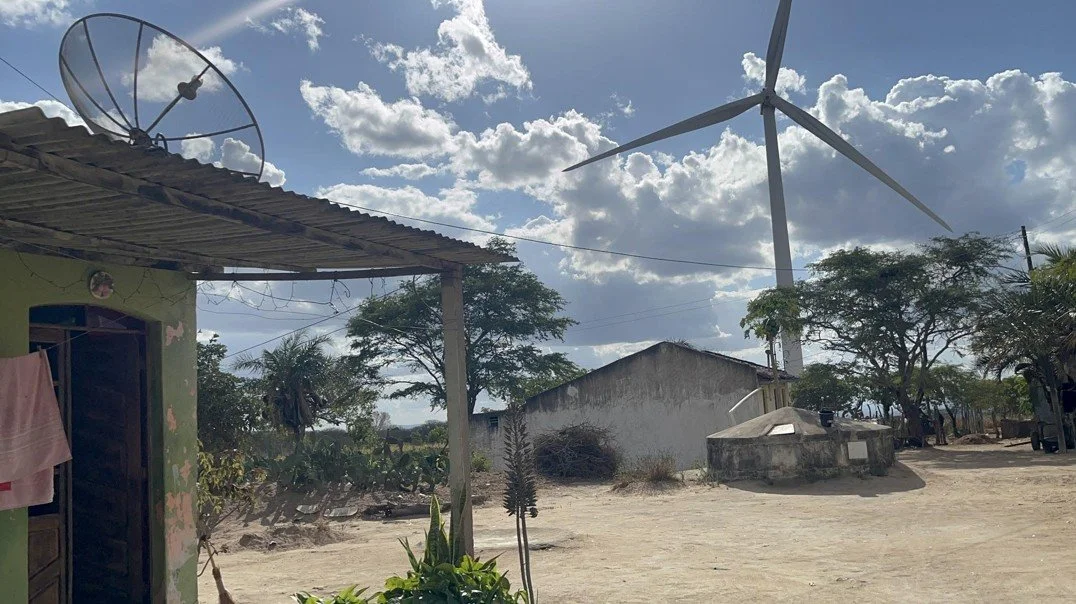
Source: City of Caetés, Pernambuco, predominantly located in the Caatinga. Original photo by Bianca Cavalcanti as part of her work for the Human Rights Clinic at UFPE’s aSIDH (Access to the Inter-American Human Rights System), 2026
In municipalities like Caetés, in the Agreste region of Pernambuco, those who live alongside wind farms every day offer a very different account from what appears in corporate sustainability reports or in major media outlets.
And, drawing on the perspectives of feminist and agroecological movements in Latin America, the term “body-territory” encapsulates the exploitation taking place in northeastern Brazil. Simply put, (neo)colonization, patriarchy, and capitalism never affect just the land or just the people—they affect both at the same time, because there is a symbiosis with the territory. By affecting both simultaneously, women’s bodies—mostly Black women in situations of socioeconomic vulnerability—tend to bear the brunt of this dual violence.
Peasant women, in their often triple workload—caring for the home, the farm, their children, and the animals—are the ones who feel, in their bodies and in their daily lives, the weight of an energy transition that, for many communities, is anything but fair.
The Green Paradox: The Loss of Women’s Territory
The energy transition is now treated as unquestionable, and, in fact, the international community urgently needs to stop relying on fossil fuels. And Brazil, with its abundance of sun and wind, has become a key player in this international discussion. So, the problem is not renewable energy itself, but the exploitative and purely market-driven model, sustained by a handful of large economic groups—many of them dependent on foreign capital—that treat the Northeast as a business frontier, not as a living, diverse place.
In practice, the expansion of wind farms in the Northeast has repeated a very old logic: treating rural and traditional territories as empty spaces (it’s worth noting that this “emptiness” extends to cultural, social, economic, and ecosystemic aspects), available to the interests of outsiders. The literature refers to this as “green colonialism” or “energy colonialism”—that is, entire communities become disposable in the name of the economic interests of the much-touted “progress and development” and international decarbonization targets that these communities never helped define, thereby cementing this territory as a sacrifice zone.
The landscape of wind farm oligopolies highlights the enormous difference between a technical energy transition—designed to generate profit and, consequently, meet carbon targets—and a Just Energy Transition, which requires three things: equitable accountability, a balanced distribution of costs and benefits, and the genuine participation of the local population in energy decisions, without shifting the burden onto those who already have less bargaining power.
It is this second transition that has not yet reached Caetés or the Brazilian Northeast.
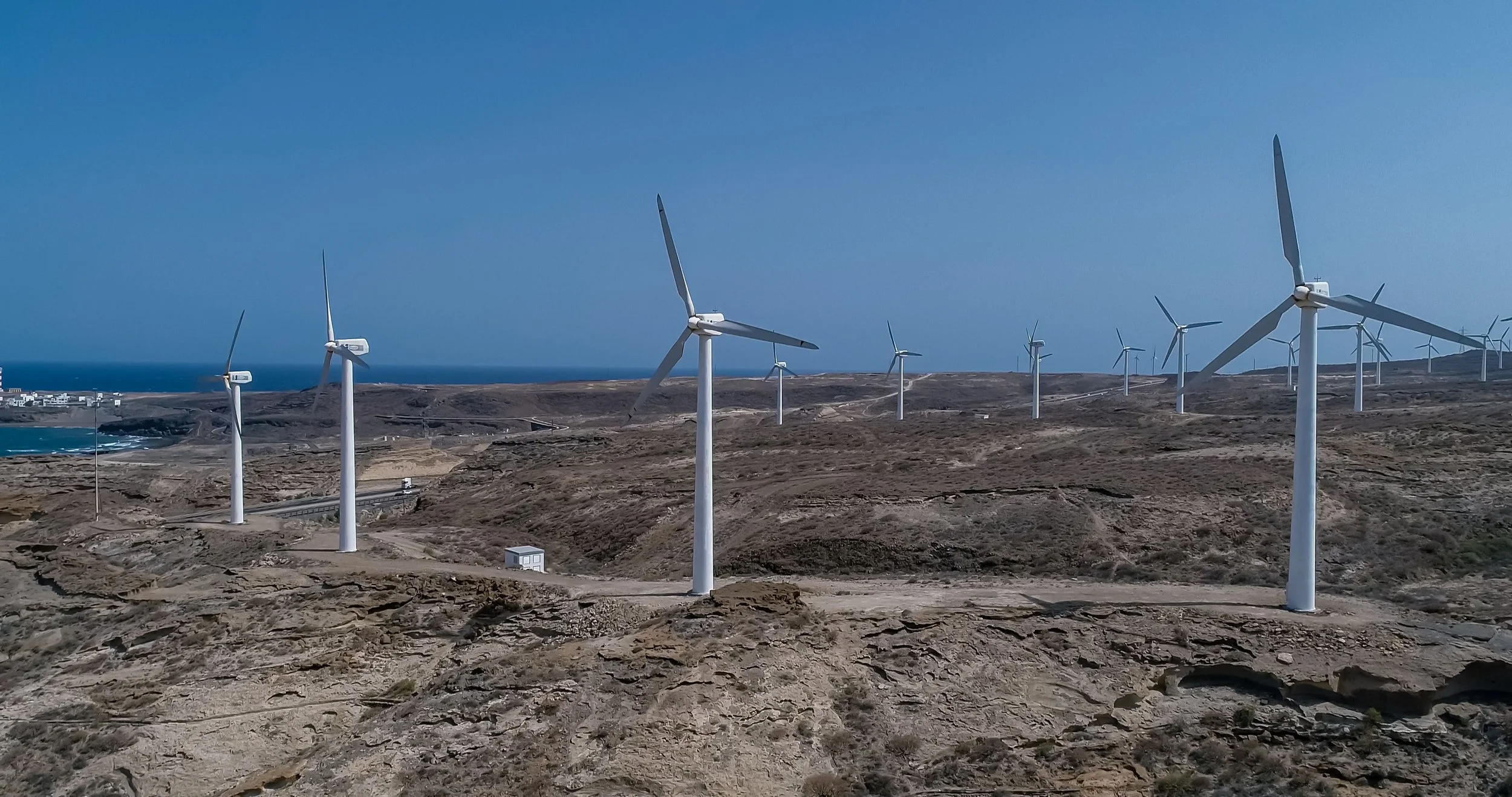
Credits: Mikhail Nilov
The Noise That Keeps You Awake: Silent Illness and the Burden of Care
Anyone who has never lived near a wind turbine can hardly imagine what it’s like to live, 24 hours a day, with the continuous mechanical sound of the spinning blades. Residents of the region describe nights when the only way to sleep is with earplugs. Chronic insomnia, anxiety, depression, and hypertension frequently appear in these accounts—symptoms that part of the literature has already grouped under the term “wind turbine syndrome.” During a field trip to the Caetés region, within less than 24 hours, it was already possible to physically feel some of these consequences; acute headaches and irritability are the first indicators.
The impact isn’t limited to people. Animals stressed by the constant noise produce less milk and fewer eggs; bees and birds are disappearing from the region—a development that directly affects subsistence agriculture and agroecology, food-production methods that have sustained a large portion of these families for generations.
And this is where the burden falls. In rural families in the Northeast, it is mostly women who care for those who fall ill—from the child who can’t sleep to the elderly person who becomes more anxious. When the entire household becomes ill due to the noise from the turbines, care work—unpaid, invisible in statistics, and indispensable to today’s social fabric—multiplies; consequently, the home becomes a greater source of illness, and it is the woman who keeps that household afloat, often alone, with her body and mind.
When the wind carries away the “life plan”
In international human rights law, there is a concept that has been little explored outside the Inter-American Human Rights System but is extremely powerful for understanding what is happening in the Northeast: “damage to one’s life project,” as recognized by the Inter-American Court of Human Rights. The concept emerged in the judgment of the case Loayza Tamayo v. Peru before the Inter-American Court of Human Rights, when the Court held that certain violations cause harm or limit an individual’s ability to choose the course of their own existence—a principle commonly applied to collective life projects, such as the Brazilian case of the Quilombolas of Alcântara.
The idea is simple to explain, though difficult to remedy: when someone suffers such profound harm that they lose the freedom to follow the path they had chosen for their own life, this harm goes far beyond material loss. It is the frustration of the future that the person had been building—a future that can also be built collectively.
In the affected rural areas, this happens in very concrete ways. Vague lease agreements—often signed without families truly understanding what they were authorizing—result in the fencing off of land and the installation of industrial structures in the midst of what were once farmlands, livestock pastures, and community life. Families who planned to continue farming the land, raising their children there, and growing old in that place find themselves forced into rural exodus.
When we bring in a gender perspective, this rupture takes on a particular significance. Ancestral and generational knowledge—such as which plants cure what, when to plant, and how to raise small animals—is passed down from mother to daughter, from grandmother to granddaughter. So, when the backyard disappears and families are forced to migrate, it is not only the connection to the land that is lost, but also the connection to their very identity—it is severed. The collective, feminine life project is shattered along with the fence, and a line of transmission of knowledge and autonomy built up over generations of women is lost.
Women’s Backyards: Body and Territory in Conflict
This is where the gender dimension becomes impossible to ignore. In rural communities in the Northeast, productive backyards—the spaces around the home where vegetables and medicinal plants are grown and small animals are raised—have historically been territories of women’s autonomy. It is there that many secure their own income, ensure food security for their families, and have a space for decision-making that does not depend on anyone else .
When a wind farm arrives, these backyards are the first to disappear—whether due to noise, the fencing off of land, or the forced reorganization of domestic space. Losing the backyard isn’t just about losing production: it’s about losing economic autonomy and a place of power within the community itself.
It is no coincidence that movements such as the Peasant Women’s Movement (MMC), active in Pernambuco and throughout the Northeast, use precisely the term “body-territory” to describe their struggle: for these women, defending the land and defending their own bodies are one and the same cause. When the territory is invaded, so is the body of the woman who depends on it.
From the Green Transition to the Just Transition
None of these impacts are inevitable. They are the result of choices—about how to negotiate contracts, about who sits at the decision-making table, about what kind of consent is considered valid, and, above all, about who is heard and who is merely “informed.”
Viewing the energy transition as a process of decolonization means demanding that redress—when harm occurs—not be limited to financial compensation. It means truly rebuilding the life plans that have been disrupted and respecting communities’ sovereignty over their own territories—before, during, and after the installation of any project. This movement will be described as part of a Latin American “eco-territorial shift,” according to Argentine sociologist Maristella Svampa , a moment in which a new matrix of social resistance is taking shape—one that no longer separates the defense of the land from the defense of feminist, Indigenous, and community values.
It is worth remembering: the women of Pernambuco’s Agreste region are not merely victims of this history, but rather protagonists in the defense of the land and the Just Energy Transition. Initiatives such as the Escola dos Ventos and the Rural Women’s Movement show that these communities are already organizing, generating knowledge about their own territory, and fighting, inch by inch, for the right to decide what “clean energy” should mean for those who depend on it for their livelihood—and not just for those who profit from it.
The energy transition the world needs cannot be built at the expense of silencing the women who sustain life in rural areas. Listening to these voices is not a mere detail of a just transition—it is the very condition for its existence.